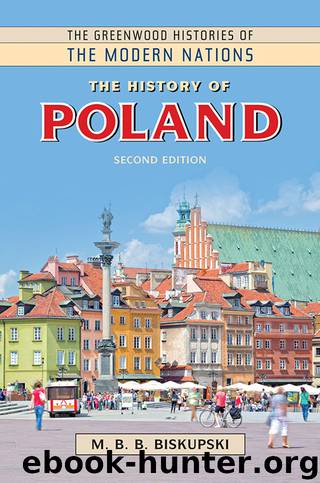
The History of Poland by M. B. B. Biskupski
Author:M. B. B. Biskupski
Language: eng
Format: epub
Publisher: ABC-CLIO
Politics
The first postwar government of Poland had a most unappetizing origin. Negotiations were held in Moscow in the spring of 1945. The Americans were represented by President Franklin Roosevelt’s special emissary, Harry Hopkins, whose concern for the Poles was slight indeed and sympathy for the Soviets unbounded. Stalin agreed that the Lublin Committee would be expanded to twenty-one by the addition of five émigré Poles, but only those who had been approved by the Soviets. Mikołajczyk, as we noted, tried vainly to convince the Western powers to regard him as their means of maintaining influence in Poland. Because the peasants represented the bulk of the Polish population, Mikołajczyk hoped to use them to gain a non-Communist voice for his Polish Populist Party (Polskie Stronnictwo Ludowe [PSL]). Although many of his compatriots regarded him as a representative of the West, in reality he had no real leverage and his party meant nothing. The Provisional Government of National Unity installed itself in Warsaw. Though supposedly representing five different parties, the Polish Workers’ Party (Polska Partia Robotnicza [PPR]) held all the key posts, including the Ministries of Defense and Public Security. Poland began its new history with a government created at the behest of its traditional enemy and staffed by a party that had never enjoyed a popular following.
The initial postwar years of Polish politics are exceedingly complex, though simple in outline. The Communists rapidly monopolized power in the state: opposition parties were preemptively declared illegal, crushed by terror, or subsequently neutralized and absorbed. Many patriots were jailed and killed. The ability of the Communists to achieve this position is explained by a combination of a powerful Soviet military force menacingly stationed in the country—300,000 in late 1946—and the abandonment by the West of democratic elements in Poland. The population was demoralized, and most people were willing to accept the rule of the Communists if the resulting civil order would allow them to reconstruct their devastated country.
Hence, the powerful prewar, nationalist movement, or endecja; the Christian Democrats; and any other parties that could be classified as politically moderate or right were declared illegal. More open opposition to the Communists was dealt with brutally. Certain elements of the Home Army (Armia Krajowa [AK]) and the fanatically nationalist National Armed Forces (Narodowe Siły Zbrojne [NSZ]) maintained armed resistance to the new authorities for several years. The numbers involved are very difficult to ascertain, but many thousands were involved at least part-time in guerrilla warfare after 1945. Thus, a virtual civil war raged in Poland, especially in its southern and eastern territories where the forests and mountains were a haven to insurgents for years. At least 30,000 Polish casualties, and possibly many more, resulted. This grisly chapter in Polish history still awaits complete elucidation. In any event, the most militant anti-Communists were removed from any legal participation in politics.
This left the political spectrum to a variety of socialists, as well as the now-powerless peasant parties. The first postwar elections, held in 1946 after much delay, were preceded by manipulation and intimidation and were conducted with farcical unfairness.
Download
This site does not store any files on its server. We only index and link to content provided by other sites. Please contact the content providers to delete copyright contents if any and email us, we'll remove relevant links or contents immediately.
| Africa | Americas |
| Arctic & Antarctica | Asia |
| Australia & Oceania | Europe |
| Middle East | Russia |
| United States | World |
| Ancient Civilizations | Military |
| Historical Study & Educational Resources |
Room 212 by Kate Stewart(5121)
The Crown by Robert Lacey(4817)
Endurance: Shackleton's Incredible Voyage by Alfred Lansing(4783)
The Iron Duke by The Iron Duke(4356)
The Rape of Nanking by Iris Chang(4213)
Joan of Arc by Mary Gordon(4110)
Killing England by Bill O'Reilly(4001)
Say Nothing by Patrick Radden Keefe(3985)
I'll Give You the Sun by Jandy Nelson(3447)
Shadow of Night by Deborah Harkness(3368)
Hitler's Monsters by Eric Kurlander(3343)
Mary, Queen of Scots, and the Murder of Lord Darnley by Alison Weir(3210)
Blood and Sand by Alex Von Tunzelmann(3205)
Eleanor & Park by Rainbow Rowell(3174)
Darkest Hour by Anthony McCarten(3133)
Margaret Thatcher: The Autobiography by Thatcher Margaret(3082)
Book of Life by Deborah Harkness(2939)
Red Famine: Stalin's War on Ukraine by Anne Applebaum(2934)
The One Memory of Flora Banks by Emily Barr(2863)
